
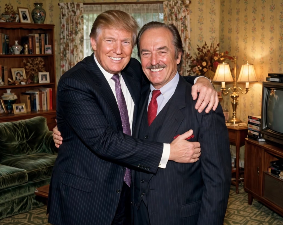
🇺🇸 THE STORY OF FRED TRUMP: THE FATHER BEHIND DONALD TRUMP’S FAMILY AND REAL ESTATE LEGACY 🏢
The Correct Answer Is D — Fred Trump!
Have you ever wondered who Donald Trump’s father was, what kind of life he lived, how he built his real estate business, and what role he played in the history of the Trump family? 🤔
Behind every famous family is a story filled with ambition, challenges, opportunities, and decisions that shape the future. The story of Fred Trump is an important part of understanding Donald Trump’s background, because Fred spent decades building a property business that later influenced his son’s career.
Fred Trump was an American real estate developer who became known for constructing and managing residential properties, particularly in New York City. He was born long before his son became a nationally recognized businessman, television personality, and president of the United States.
His life began in a period when America was changing rapidly. Cities were expanding, families were searching for affordable homes, and the construction industry was becoming an important part of the country’s economic development.
Fred Trump entered that world at a young age. Through years of work, business decisions, and property development, he established a real estate enterprise that became an important part of his family’s financial history.
But his story is about more than money and buildings. It also involves family relationships, business opportunities, controversy, and the complicated legacy that parents can leave for their children.
Let’s explore the story step by step.
🏡 PART 1: THE EARLY LIFE OF FRED TRUMP
Fred Trump was born on October 11, 1905, in New York City, New York.
His full name was Frederick Christ Trump. He grew up in a family with German roots during a period when New York was developing into one of the most important cities in the United States.
At the beginning of the twentieth century, New York was experiencing significant growth. New residents arrived in search of employment, businesses expanded, and neighborhoods changed as the city developed.
Housing was an essential part of this transformation. Workers needed places to live, families needed apartments, and builders saw opportunities to construct residential buildings.
Fred grew up during this changing period, and real estate would eventually become the central focus of his professional life.
His father, Frederick Trump, had immigrated to the United States from Germany and had worked in several businesses. His mother, Elizabeth Christ Trump, would later play an important role in establishing the family construction business.
When Fred was still young, his father died during the influenza pandemic of 1918.
Losing a parent during childhood can profoundly change a family’s circumstances. Fred was only twelve years old when his father died, leaving his mother to care for the family.
Elizabeth had to make important decisions about the family’s future. Instead of allowing the family’s financial activities to disappear, she worked toward building a business that could support them.
This early experience became part of the background to Fred’s later career.
It is important, however, not to assume that one childhood event explains an entire person’s personality. Fred’s eventual success in real estate also depended on business opportunities, family support, the development of New York City, and the decisions he made throughout his life.
What is clear is that he grew up in a family that became increasingly involved in property development.
For Fred, the construction industry would soon become more than a family interest. It would become his life’s work.
🏗️ PART 2: HOW THE FAMILY BUSINESS BEGAN
During Fred Trump’s youth, his mother Elizabeth began building the family’s real estate enterprise.
In 1927, Elizabeth and Fred established E. Trump & Son, a business that focused on construction and property development.
Fred was only twenty-one or twenty-two years old, depending on the date of the company’s establishment and his birthday.
Starting a business at such a young age required him to learn about the practical realities of construction, costs, property ownership, and customer needs.
A real estate developer must consider many different questions before a building can become profitable.
Where should a property be constructed?
How much will the land cost?
What materials and workers will be needed?
How many apartments can the building contain?
What rents can residents reasonably pay?
How will the developer manage expenses and maintain the property over time?
These questions are essential to the business of real estate, and Fred’s work involved the challenges associated with them.
The family business concentrated on residential construction. Instead of focusing only on large commercial skyscrapers, it developed houses and apartment buildings for people who needed places to live.
This kind of construction could offer opportunities in expanding neighborhoods where the population was growing.
The company name, E. Trump & Son, also reflected the partnership between Elizabeth and Fred. Although Fred became the more publicly recognized developer, his mother’s involvement was an important part of the company’s beginnings.
Their work helped establish the business foundation that would support the family’s later activities.
The story illustrates an important point about family businesses: the person who becomes most famous is not necessarily the only person responsible for creating the enterprise.
In this case, Elizabeth Trump played a meaningful role in the family’s early real estate history.
Over time, Fred became increasingly involved in developing residential properties, and the business expanded its activities in New York.
🏙️ PART 3: BUILDING A CAREER IN NEW YORK REAL ESTATE
New York City offered opportunities for developers during the early and middle twentieth century.
As neighborhoods grew and the demand for housing changed, builders could find opportunities by constructing new homes and apartment buildings.
Fred Trump focused heavily on residential real estate in Brooklyn and Queens, two boroughs of New York City.
His business developed houses and apartment complexes, helping establish his reputation as a property developer.
Residential construction requires more than putting bricks and concrete together. Developers must coordinate architects, builders, suppliers, contractors, inspectors, and financial arrangements.
They must also think about the people who will eventually live in the properties.
For an apartment building to remain useful, its design must meet residents’ needs, and its maintenance must be managed over time.
Property development also involves financial risk. Construction expenses can increase, rents can change, and economic conditions can influence whether a project succeeds.
Fred’s career unfolded during periods of both economic difficulty and growth.
The Great Depression, which began in 1929, created serious financial problems across the United States. Businesses failed, employment declined, and many families struggled to pay their bills.
The real estate industry was affected by these wider economic conditions.
Developers had to deal with changing demand, financial uncertainty, and the challenge of keeping projects viable.
The following decades brought further changes. World War II affected construction materials and the economy, while the postwar period created substantial demand for housing.
After the war, many American families sought homes as the population grew and the economy changed.
Developers who could build residential properties in suitable locations had opportunities to expand.
Fred Trump took part in this period of housing development, particularly in New York.
His business became known for constructing substantial numbers of residential units. Over the years, the Trump family accumulated property assets that contributed to its wealth.
These accomplishments helped establish Fred’s reputation in the real estate industry.
However, a balanced understanding of his career requires acknowledging that the business operated within wider economic, political, and social circumstances. The story of a property developer cannot be separated entirely from the neighborhoods, residents, and public policies that affected housing.
Fred Trump’s career was one part of the much larger history of American real estate.
💼 PART 4: BUSINESS, OPPORTUNITY, AND FINANCIAL DECISIONS
Real estate is an industry in which long-term planning can be extremely important.
A building may take months or years to complete, and the money invested in construction may not be recovered immediately.
Developers must therefore consider both immediate expenses and future returns.
Fred Trump built his career around residential properties, where income could come from selling homes or collecting rent from apartments.
Owning rental properties can provide continuing revenue, but it also creates responsibilities.
Buildings require repairs, management, maintenance, and compliance with applicable laws. Residents expect safe and functional homes, and property owners must address the practical needs associated with housing.
The business also depends on market conditions.
When demand for housing increases, property values and rental opportunities may change. When the economy weakens, tenants may struggle financially, and owners may face greater difficulties managing their properties.
Fred Trump worked in this industry across several decades, a period in which New York experienced substantial economic and demographic changes.
His business activities contributed to the family’s financial resources and helped create a foundation for Donald Trump’s later real estate career.
Still, it is important to distinguish between having a family business and independently creating an entirely separate fortune.
Donald Trump entered adulthood with access to family connections, business experience, and financial resources that many aspiring developers do not have.
Those advantages were part of his background.
At the same time, Donald developed his own business interests and pursued projects that differed in focus and public profile from his father’s residential developments.
Understanding the relationship between their careers requires looking at both the opportunities Fred helped create and the decisions Donald later made himself.
The father and son were connected through family, business, and real estate, but they were not the same person, and their careers should not be treated as identical.
👨👩👧👦 PART 5: FRED TRUMP’S FAMILY LIFE
Fred Trump’s life was not limited to construction sites and business offices. Family was also an important part of his personal history.
In 1936, he married Mary Anne MacLeod, who had immigrated to the United States from Scotland.
Together, Fred and Mary Anne raised five children:
- Maryanne Trump Barry
- Fred Trump Jr.
- Elizabeth Trump Grau
- Donald Trump
- Robert Trump
Each child followed a different path, and their lives developed in different ways.
Maryanne Trump Barry became a lawyer and later served as a federal judge.
Fred Trump Jr., often known as Freddy, worked as an airline pilot. His life took a different direction from the family real estate business.
Elizabeth Trump Grau pursued a career in banking.
Donald Trump became involved in real estate and later gained widespread attention through business, television, and politics.
Robert Trump worked in the family business and maintained a comparatively lower public profile than Donald.
Growing up in a family associated with real estate meant that the children had a connection to the world in which Fred had spent much of his working life.
However, children in the same family do not necessarily develop the same interests or ambitions.
Their careers reflected different choices, circumstances, and personalities.
Fred and Mary Anne’s household was part of a family whose name would become increasingly recognizable in American public life.
For Donald, his father’s business career provided an early introduction to the property industry.
The buildings, business discussions, and family relationships surrounding him helped shape the environment in which he grew up.
Fred’s influence on Donald’s later career is therefore an important subject when studying the Trump family’s history.
Yet family influence is not the same as complete control over another person’s future. Donald’s later decisions, business ventures, and political ambitions belonged to his own adult life.
🧠 PART 6: WHAT DONALD TRUMP LEARNED FROM HIS FATHER
Donald Trump was born on June 14, 1946, in Queens, New York City.
At that time, Fred Trump had already established a substantial presence in the residential real estate business.
Donald grew up during the postwar period, when the American economy was changing and suburban development was expanding.
His father’s business gave him exposure to the property industry from an early age.
As he grew older, Donald became interested in real estate and eventually joined the family business.
He attended the Wharton School at the University of Pennsylvania, where he studied economics.
After completing his education, Donald worked in the family enterprise and became involved in its operations.
Fred’s business provided Donald with experience, contacts, and access to resources that helped him begin his career.
Donald later moved toward projects that attracted attention beyond the residential neighborhoods associated with his father’s business.
He became known for pursuing prominent properties, including hotels, commercial buildings, and developments connected to the Manhattan real estate market.
His business style and public image differed from his father’s.
Fred was primarily known as a residential developer whose business concentrated on properties in Brooklyn and Queens.
Donald became known for high-profile projects, branding, television appearances, and an increasingly public business identity.
This distinction matters because the story of Donald Trump’s career is not simply the story of his father repeated in another generation.
Fred helped establish the family’s real estate resources, while Donald developed his own professional identity.
The relationship between inherited advantages and personal decisions is often complicated.
Having access to a family business can provide a valuable starting point, but running and expanding a business also requires decisions about financing, management, partnerships, and risk.
Donald Trump benefited from the foundation his father had built, while his later career included ventures and controversies of its own.
To understand either man properly, it is necessary to consider both the opportunities available to him and the choices he made.
🏘️ PART 7: THE IMPORTANCE OF RESIDENTIAL HOUSING
One of the defining features of Fred Trump’s career was his emphasis on residential real estate.
Housing is more than a financial asset. It is also an essential part of everyday life.
Families need places to sleep, prepare meals, raise children, and build relationships with their communities.
Apartment buildings and houses can influence how neighborhoods develop, how people travel to work, and what services are available nearby.
During the twentieth century, the New York metropolitan area experienced major changes in population and housing demand.
Developers helped respond to those changes by building and managing residential properties.
Fred Trump became a significant participant in this process.
His company developed numerous housing units, and his work contributed to the physical growth of parts of New York.
At the same time, housing development raises important questions about affordability, quality, and equal access.
A building may be financially successful for its owner while still raising questions about whether residents are treated fairly or whether homes are accessible to different groups of people.
This is one reason historians and observers examine property developers from more than one perspective.
The construction of buildings is an economic activity, but housing also has social consequences.
The people who live in a neighborhood are affected by property decisions, rental policies, maintenance practices, and broader housing regulations.
Fred Trump’s career therefore belongs to a larger discussion about American urban development.
His business achievements and the controversies associated with his housing practices are both relevant to understanding his legacy.
A complete account should not reduce his life to a simple tale of success or failure. It should examine the available evidence and recognize that the history of real estate involves developers, residents, governments, and communities.
⚖️ PART 8: CONTROVERSIES AND THE IMPORTANCE OF FAIR HOUSING
Fred Trump’s business career also involved serious controversy.
In the early 1970s, the United States Department of Justice brought a federal fair-housing case against Fred Trump, Donald Trump, and their company.
The case concerned allegations of discrimination against prospective tenants in properties managed by the company.
The federal Fair Housing Act, enacted in 1968, prohibited specified forms of discrimination in housing.
The case attracted attention because it involved a prominent New York real estate business and raised questions about equal access to housing.
In 1975, the case was resolved through a consent decree.
A consent decree is a formal agreement approved by a court that sets out obligations for the parties involved. The settlement included provisions intended to address the government’s allegations and improve compliance with fair-housing requirements.
The settlement was not an admission of guilt by the defendants.
Nevertheless, the case remains an important part of the historical record of the Trump family’s real estate business.
It is relevant because it demonstrates that property development must be evaluated not only through construction numbers and financial results but also through the treatment of residents and prospective tenants.
Fair housing is based on the principle that people should have equal opportunities to seek housing without unlawful discrimination.
This principle is important because access to housing affects education, employment, family stability, and participation in community life.
The controversy surrounding Fred Trump’s company illustrates the legal and ethical questions that can arise in the real estate industry.
It also reminds us that business success does not eliminate the need for accountability.
When studying historical figures, it is important to distinguish allegations, legal settlements, court findings, and admissions. These are not interchangeable terms.
A responsible account explains what happened without exaggerating the evidence or ignoring significant events.
Fred Trump’s legacy includes substantial real estate activity, a family business that continued into another generation, and controversies that remain relevant to discussions about fair housing.
🌆 PART 9: A CHANGING CITY AND A CHANGING FAMILY BUSINESS
As Fred Trump continued his career, New York City changed around him.
Neighborhoods evolved, transportation networks expanded, and the relationship between city centers and suburban areas shifted.
Real estate developers had to adapt to changes in demand, construction costs, financing, and government policy.
Some properties became more valuable as neighborhoods grew, while other areas experienced economic challenges.
A developer working across several decades could not rely on exactly the same market conditions throughout an entire career.
Fred’s business remained closely associated with residential properties in Brooklyn and Queens.
The family business accumulated experience in construction and property management, and its assets became part of the resources available to the next generation.
Donald Trump eventually developed a more public-facing business identity.
He pursued prominent properties and projects that attracted media attention, and he became known for placing his name on buildings and other ventures.
The difference between the two generations reflected broader changes in business culture and media.
During Fred’s career, a developer could become successful largely through regional real estate activities without becoming a nationally recognized celebrity.
By the time Donald developed his own public profile, television and mass media offered new opportunities to promote a business identity.
Donald later became the host of the reality television program The Apprentice, which introduced him to a wider audience.
His television career helped connect his name with ideas of business leadership, negotiation, and competition.
Years later, he entered presidential politics and became a central figure in American political life.
These developments made the Trump family name internationally recognizable.
Fred Trump did not experience his son’s entire political career. He died in 1999, years before Donald first became president.
Even so, the property business Fred developed remained an important part of the family’s history.
💰 PART 10: WEALTH, INHERITANCE, AND FAMILY LEGACY
The question of wealth is often central to discussions about prominent business families.
Fred Trump accumulated substantial real estate assets over the course of his career.
Those assets contributed to the financial position of the Trump family and became relevant to discussions of Donald Trump’s business beginnings.
It is important to understand that wealth can be transferred across generations in several ways.
It may pass through inheritance, gifts, loans, ownership arrangements, business partnerships, or other financial structures.
These arrangements can give family members opportunities that are not equally available to people who must begin without significant resources.
Donald Trump entered the real estate industry with advantages arising from his family’s business.
This background helped him access opportunities and gain experience in an industry that can require considerable capital.
However, the relationship between family wealth and later financial outcomes can be complicated.
A person’s eventual financial position may reflect inherited assets, independent business decisions, market conditions, borrowing, profits, losses, and legal obligations.
For that reason, it is useful to distinguish the wealth Fred accumulated from the separate business activities Donald pursued.
Fred’s story is primarily the story of a developer who built a residential real estate enterprise.
Donald’s story includes the development of his own properties and brand, his public career, and his later political activities.
The two stories overlap, but they should not be confused.
Family legacy can provide opportunities, but it also creates expectations and public scrutiny.
When a family becomes famous, later generations often find their lives interpreted through the achievements and controversies of earlier generations.
The Trump family is an example of how a business legacy can become connected to a much larger public story.
👨👦 PART 11: THE PERSONAL SIDE OF FRED TRUMP’S LEGACY
It is easy to discuss a famous person’s life entirely through business statistics, buildings, and public controversies.
Yet a person’s history also includes family relationships and personal experiences that are not always visible to the public.
Fred Trump was a husband and father who raised five children with Mary Anne Trump.
His children developed different careers and public identities, and their lives were shaped by a combination of family circumstances and personal choices.
One especially important family story involved Fred Trump Jr.
Fred Jr. pursued a career as an airline pilot rather than following the same path in real estate.
He struggled with alcohol use and died in 1981 at the age of forty-two.
His life and death were later discussed publicly by members of the family, including Donald Trump, who described how his brother’s experiences influenced his own views about alcohol.
This part of the family’s history demonstrates that financial resources and business success do not remove the challenges that families can experience.
It also illustrates why a complete family history should not focus only on the person who becomes most famous.
Each family member has a distinct life story.
Fred Trump’s legacy therefore includes the business enterprise he built, the opportunities available to his children, and the complicated relationships and experiences that developed within the family.
The personal side of a public figure’s life can be difficult to reconstruct fully because not every private conversation or experience becomes part of the historical record.
It is best to rely on documented information and avoid assuming that outsiders know everything about a family’s private life.
🏛️ PART 12: FRED TRUMP’S FINAL YEARS
Fred Trump continued to be associated with real estate during his later life.
By the final decades of the twentieth century, he had become an established figure in New York property development.
His career had spanned periods of major economic change, from the early twentieth century through the postwar housing boom and into the modern era.
Over those decades, the city in which he worked had transformed significantly.
Buildings, neighborhoods, and housing markets changed, while the real estate industry became increasingly connected to finance, public policy, and broader economic conditions.
Fred’s family business remained an important part of his identity.
However, his later years also brought personal challenges.
He developed Alzheimer’s disease and died on June 25, 1999, at the age of ninety-three.
His death marked the end of a long life that had included decades of business activity and a central role in the history of the Trump family.
At the time of his death, Donald Trump was already a recognizable businessman, although he had not yet entered the presidency.
Donald’s later political career would bring the family name to an even larger audience.
Fred did not live to see those developments, but his influence on the family’s business background remained part of the story.
When people ask who Donald Trump’s father was, the answer is straightforward: Fred Trump.
Understanding why that answer matters requires looking beyond the name and considering the life behind it.
Fred was a real estate developer, a husband, a father, and a businessman whose work helped shape the opportunities available to his family.
🌟 PART 13: WHAT CAN WE LEARN FROM THIS STORY?
Fred Trump’s life offers several lessons about business, family, opportunity, and historical judgment.
Lesson 1: Family background can influence opportunity.
Donald Trump grew up in a family with an established real estate business. That gave him access to knowledge, resources, and professional connections that helped him enter the industry.
Recognizing those advantages provides a more complete understanding of his early career.
Lesson 2: Business success takes place within a wider economy.
Fred Trump’s work occurred during periods of economic growth, financial hardship, and changing housing demand.
No developer operates entirely outside the influence of economic conditions, laws, or the communities in which properties are built.
Lesson 3: A legacy can include both achievements and controversies.
Fred Trump developed a substantial real estate business, but his company’s history also included a significant fair-housing case.
A balanced account recognizes both facts rather than presenting a historical figure as entirely successful or entirely unsuccessful.
Lesson 4: Family members can follow different paths.
Fred’s children pursued different careers and interests. Their experiences show that growing up in the same household does not mean every person will choose the same future.
Lesson 5: Famous people should be understood through evidence.
Stories about prominent families often attract exaggerated claims, rumors, and oversimplified explanations.
Checking dates, names, documented events, and legal records helps distinguish reliable history from speculation.
Lesson 6: Housing has consequences beyond business profits.
Buildings provide places for people to live. Decisions about housing can affect communities for generations, making fairness and responsibility important considerations in real estate.
These lessons help place Fred Trump’s life within a wider historical context.
His story is not merely a question on a multiple-choice quiz. It is an entry point into the history of a family, an industry, and a changing American city.
🧠 PART 14: LET’S REVIEW THE FOUR QUIZ ANSWERS
Now that we have explored Fred Trump’s background, let’s return to the original question:
“What is the name of Donald Trump’s father?”
Here are the four choices from the quiz.
🔹 OPTION A — ROBERT TRUMP
Robert Trump was Donald Trump’s younger brother. He was a member of the Trump family and worked in the family’s business, but he was not Donald’s father.
Therefore, option A is incorrect.
🔹 OPTION B — JOHN TRUMP
John George Trump was Donald Trump’s uncle. He was an electrical engineer and professor at the Massachusetts Institute of Technology.
Although he was a member of the extended Trump family, he was not Donald Trump’s father.
Therefore, option B is incorrect.
🔹 OPTION C — WILLIAM TRUMP
William Trump is not the correct answer to this question. Donald Trump’s father was not named William Trump.
Therefore, option C is incorrect.
🔹 OPTION D — FRED TRUMP
Fred Trump was Donald Trump’s father. He was born in New York City in 1905 and became a real estate developer whose business focused heavily on residential properties in Brooklyn and Queens.
He married Mary Anne MacLeod in 1936, and they had five children, including Donald Trump.
Fred’s career helped establish the family’s real estate background and played an important role in the circumstances surrounding Donald Trump’s early business life.
Therefore, option D is correct! ✅
🎉 FINAL CONCLUSION: THE MAN BEHIND THE ANSWER
The story of Fred Trump is an important chapter in the history of the Trump family.
Born in New York City in 1905, he entered the real estate business at a young age and became a developer of residential properties.
Working alongside his mother in the family’s early enterprise, he helped establish a business that expanded over the following decades.
His work took place during a period of major change in American cities, when housing demand, economic conditions, and government policies influenced the development of neighborhoods.
Fred married Mary Anne MacLeod, raised five children, and helped create the business environment in which Donald Trump began his own real estate career.
His legacy is complex. It includes a substantial property business, opportunities passed to another generation, and controversies that are important to the history of fair housing.
Fred Trump died in 1999, but his name remains part of the story of one of America’s most widely recognized political families.
And that brings us back to the original quiz.
If you were asked to identify Donald Trump’s father, the correct choice would be:
🏆 D — FRED TRUMP! 🇺🇸
📢 YOUR TURN, QUIZ LOVERS!
Did you know the answer before reading this story?
💬 Write “D — FRED TRUMP” in the comments if you chose the correct option!
👍 Like this post if you enjoy learning interesting facts about American history.
🔄 Share the quiz with your friends and family to see who knows the answer.
🧠 Keep challenging your brain with more history questions, famous-family stories, and educational quizzes!
Remember: Every question is an opportunity to learn something new! 🎓🇺🇸