

“Daddy, stop the car!” My five-year-old daughter screamed so suddenly that I slammed on the brakes before I understood what she was saying. Rain hammered against the windshield, and the headlights of passing cars reflected across the wet streets of Manhattan. It was almost nine o’clock at night, and we were returning from a hotel renovation site when Valerie pressed both hands against her window. “Daddy, please look! There are two little girls sleeping beside the garbage. They look exactly like me!” I turned toward the sidewalk, expecting to see two homeless children who happened to resemble my daughter. Instead, I saw something that would destroy everything I believed about the past five years of my life.
Beneath the awning of a closed print shop, two little girls lay curled together on a soaked piece of cardboard. They were barefoot, trembling, and wearing clothes too thin for the freezing rain. One had wrapped her arms protectively around the other. Their dark curls were tangled, their cheeks were pale, and their small hands looked almost blue from the cold. I pulled over, switched on the hazard lights, and stepped into the rain. “Please, mister,” the older-looking girl whispered when she saw me approaching. “We didn’t steal anything. We’re leaving.” I crouched several feet away. “Nobody is accusing you, sweetheart. I just want to help.” She looked at me suspiciously, but when the smaller girl lifted her head, I forgot how to breathe. Her eyes were green with tiny golden flecks, exactly like my late wife’s. The other girl had my daughter’s cleft chin, dark curls, and a tiny star-shaped birthmark behind her left ear. Valerie had the same mark.
My name is Brett Calder. I was thirty-nine years old, the owner of a successful real estate and hospitality company, and a widowed father raising one little girl. Five years earlier, my wife Lena had supposedly died giving birth to triplets. My mother-in-law, Eunice, told me that only one baby survived. I named her Valerie, exactly as Lena had wished. For five years, I believed my other two daughters had died before I could hold them. But when I asked the little girls their names, the older one whispered, “I’m Vera, and she’s Violet.” My heart nearly stopped. Those were the exact names Lena and I had chosen for our triplets: Valerie, Vera, and Violet.
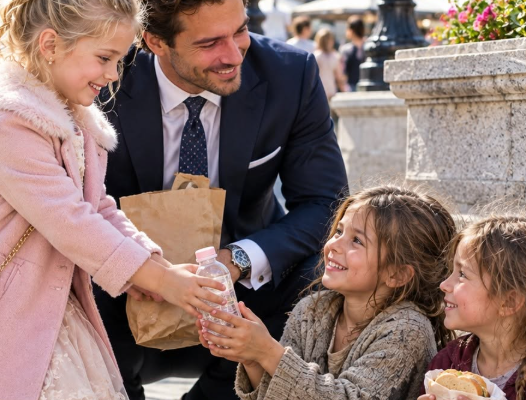
Valerie climbed out of the car carrying her pink kindergarten backpack. Before I could stop her, she approached the girls and offered them her crackers. Violet accepted one, broke it in half, and gave the larger piece to Vera. “You eat,” Vera whispered. “You didn’t have breakfast,” Violet answered. Watching two five-year-old children argue over which one deserved the larger piece of food nearly broke me. I had spent the afternoon discussing expensive hotel furniture while two little girls who might be my daughters were sleeping beside garbage bags. “Where’s your mother?” I asked gently. Vera lowered her eyes. “We don’t have a mommy.” “What about your father?” She shrugged. “Aunt Marnie says he’s far away.” I froze. Marnie was Lena’s younger sister, the woman who had disappeared after the funeral. Eunice always claimed that grief had driven her away.
“Where is Aunt Marnie now?” I asked. Vera pointed toward the large hotel down the street. “She told us to wait here while she talked to a man. She hasn’t come back in two nights.” The hotel she was pointing at belonged to me. Marnie knew I visited that property on Thursday evenings. Suddenly, finding the girls there felt anything but accidental. I called 911, requested help for two abandoned children, and contacted my hotel security manager for blankets and warm food. While we waited, Valerie sat beside Vera and Violet, showing them the little birthmark behind her ear. Both girls had matching marks. Three identical faces, three identical birthmarks, and three names chosen before they were born. I wanted to believe it was impossible, but everything in front of me suggested that someone had stolen five years of my daughters’ lives.
After we moved the girls into the warm hotel lobby, Violet pulled a silver locket from beneath her shirt. “Aunt Marnie said this belonged to our mommy.” I recognized it immediately. I had given that locket to Lena on our first wedding anniversary in Vermont. It had a tiny dent in one corner from when we accidentally dropped it onto a stone walkway. My hands trembled as Violet allowed me to open it. Inside was a photograph of Lena smiling with one hand resting on her pregnant belly. Behind the photograph was a folded note written in her unmistakable handwriting: “If we’re ever separated, let all three of them know they were wanted.” Beneath the words was the date of Valerie’s birth. I stared at the message, unable to understand why Lena had written about separation when everyone claimed she had died during delivery.
I stepped into a quiet corner and called Eunice. “Do you know where Marnie is?” I asked. She became defensive immediately. When I explained that I had found two five-year-old girls who looked exactly like Valerie, she fell silent. Then she whispered, “Oh, God.” I demanded an explanation, but instead she told me something terrifying. “Brett, listen carefully. Do not bring those girls to your house.” “Why?” “Because you don’t understand what you’re getting involved in.” “Then tell me!” Her breathing became uneven. Finally, she whispered, “Some things are better left buried,” and disconnected the call.
That single sentence changed everything. Five years earlier, I had trusted Eunice when she told me Lena and two of our daughters had died. I never saw their bodies. Eunice arranged the cremation, handled the funeral, and gave me an urn while I struggled to care for newborn Valerie. Dr. Harold Tillman, the obstetrician, had explained that catastrophic complications occurred during delivery. I was devastated, exhausted, and incapable of questioning the people around me. Now I wondered whether my grief had made me easy to deceive.
The police arrived, and Officer Ramirez began documenting everything. I explained the girls’ names, the matching birthmarks, the locket, and Eunice’s strange reaction. She warned me that resemblance alone could not establish parentage and that the children’s safety had to come first. Both girls were taken to a hospital for medical evaluation. I followed them, bringing Valerie along with a trusted caregiver. My attorney, Michael Reeves, agreed to help obtain the original birth and hospital records through proper legal channels. He also promised to locate Dr. Tillman, who had retired several years earlier.
At the hospital, Vera grabbed my sleeve when she heard someone mention temporary placement. “Please don’t send us away,” she begged. “Aunt Marnie said the man at the big hotel would keep us safe.” I knelt before her. “I’ll do everything I can to help you.” She studied my face and whispered, “Are you really Valerie’s daddy?” “Yes.” Her lower lip trembled. “Aunt Marnie said our daddy might not know we were alive.” I felt tears burning behind my eyes. “Sweetheart, I didn’t know.” Vera looked toward Violet. “Then maybe you didn’t forget us.” I wrapped my arms around her, careful not to frighten her. “No. I never forgot you. I thought I’d lost you.”
Shortly after midnight, my phone rang from an unknown number. A woman whispered, “Brett?” I recognized the voice immediately. “Marnie?” She began crying. Her first question was whether the girls were safe. When I told her they were, she sobbed with relief. Then she said, “You need to find the original delivery records. Not the copies Eunice gave you.” I demanded to know what happened five years earlier. She hesitated before admitting, “Vera and Violet are your daughters. They survived. I was threatened into keeping quiet.” My legs nearly gave way. I asked who was responsible, and she whispered two names: Eunice and Dr. Tillman.
Then Marnie revealed something even more shocking. “Brett, there’s something else about Lena.” My heart hammered. “What about her?” “I saw her after the surgery.” “What?” “She was alive, Brett. They told you she died, but I saw her breathing.” I gripped the phone so tightly that my fingers hurt. “Then whose ashes did they give me?” Before she could answer, I heard footsteps and a door opening on her end. Marnie gasped. “They found me.” “Where are you?” I shouted. “Brett, don’t trust the records until you know who signed them!” The call disconnected.
Minutes later, an anonymous message arrived containing a photograph of a woman standing outside a small house. Her hair was longer, her face thinner, and her expression exhausted, but I knew her immediately. It was Lena. Beneath the photograph were six words: “SHE IS ALIVE. STOP ASKING QUESTIONS.” I stared at the screen until my vision blurred. My wife, whom I had mourned for five years, might still be alive. But the photograph raised more questions than it answered. Where had she been? Why hadn’t she contacted me? Who had taken the picture? And why was someone threatening me for trying to find my family?
The next morning, Michael arrived at the hospital with news. Dr. Tillman had retired shortly after Lena’s delivery, and several records associated with the birth contained inconsistencies. The hospital had changed ownership, but archived records were still available. We needed formal authorization and time to obtain them. Meanwhile, a court-approved DNA test could establish whether Vera and Violet were my biological daughters. I agreed immediately. The girls remained under protective supervision while authorities investigated Marnie’s disappearance and the circumstances in which the children had been left alone.
By that afternoon, Officer Ramirez had discovered that Marnie had been renting a small apartment in Brooklyn under her legal name. She had worked several jobs while raising Vera and Violet. Neighbors described her as quiet, protective, and devoted to the girls. One neighbor remembered a gray-haired woman visiting the apartment several weeks earlier. Vera had called that visitor “the lady with the white flowers.” I knew exactly who she meant. Eunice wore a white orchid brooch almost every day. When investigators questioned her, she denied visiting Marnie and claimed she knew nothing about the children. But security footage from a nearby pharmacy showed her entering Marnie’s apartment building.
That evening, I went home for the first time since finding the girls. Valerie’s bedroom was filled with toys, books, and photographs of Lena. I stood beside the window, looking at the three tiny dresses Lena had purchased before giving birth. I had kept them in a cedar chest for five years because I couldn’t bear to throw them away. One was pink, one lavender, and one pale yellow. I remembered Lena arranging them across our bed and laughing as she imagined three little girls running through the house. I sat on the floor holding the dresses, overcome by the realization that somewhere in the city, Vera and Violet had grown up without the home their mother had prepared for them.
Two days later, the DNA results arrived. Michael asked me to come to his office before opening them. I sat across from him, barely able to breathe. He unfolded the report, read it silently, and looked up with tears in his eyes. “Brett, the results establish that you are the biological father of both girls.” For several seconds, I couldn’t move. Then I covered my face and cried. I wasn’t imagining things. Vera and Violet were mine. They were the daughters I had mourned, the babies I had never held, and the little girls I had unknowingly passed through life without searching for because I had been told they were dead.
The discovery intensified the investigation. Michael obtained a court order requiring the hospital to preserve all surviving records, while investigators examined the original documentation surrounding Lena’s delivery. One archived file contained an unexpected notation: Lena had been transferred from the maternity unit to a private neurological rehabilitation facility three days after giving birth. The transfer was authorized by Eunice Whitmore and countersigned by Dr. Tillman. Another document described a severe neurological injury and prolonged periods of confusion. There was no legitimate death certificate in the hospital’s original file. The certificate I had received five years earlier appeared to have been fabricated.
I confronted Eunice at her townhouse with Michael and an investigator present. She opened the door wearing her familiar white orchid brooch. When she saw the documents in Michael’s hand, her expression collapsed. “You should have left this alone,” she whispered. I asked where Lena was. Eunice shook her head. “You don’t understand what she was like after the delivery.” “Then explain it.” She began crying and claimed Lena had suffered a serious brain injury that affected her memory, speech, and ability to recognize people. According to Eunice, doctors had warned that recovery could take years. She insisted that she had been trying to protect me from watching Lena suffer and believed the children would be better off separated.
I stared at her in disbelief. “You told me my wife was dead.” Eunice lowered her eyes. “I thought it would be easier.” “Easier for whom?” She couldn’t answer. I stepped closer. “You took my wife from me. You took two of my daughters. You let me mourn people who were alive.” Eunice began sobbing, but I felt no comfort in her tears. “Where is Lena?” I demanded. Finally, she gave us the name of a private care facility in upstate New York. She claimed Lena had been transferred several times as her condition improved. When I asked why she had kept the truth hidden after Lena began recovering, Eunice whispered, “Because by then, I didn’t know how to undo what I’d done.”
But the investigation uncovered an even darker motive. Eunice had controlled a substantial trust established for Lena and her children. Under the trust’s terms, a surviving adult beneficiary would eventually regain control of significant assets. By falsely representing Lena as deceased and concealing two of the children, Eunice had gained control over money that did not belong to her. Dr. Tillman had received unexplained payments from an account connected to Eunice. Investigators suspected the payments were linked to falsified medical and legal documents. Eunice’s story about protecting Lena had been only part of the truth.
The following morning, I drove north with Michael and Officer Ramirez, who had coordinated with local authorities. The address led to a quiet rehabilitation residence surrounded by tall trees. My hands shook as I walked through the entrance. A nurse led us into a private consultation room and confirmed that a woman named Lena Calder had once been a patient there. She had survived severe complications following childbirth, including a brain injury that affected her memory and mobility. Over several years, she had slowly recovered. But the nurse also revealed that Lena was no longer at the facility. She had been discharged nearly six months earlier into a supervised residential program.
“Where is she now?” I asked. The nurse hesitated, explaining that patient privacy rules limited what she could disclose. Michael presented the appropriate legal documentation and arranged for investigators to contact Lena’s current care team. Hours later, we received confirmation that she was living in a small house under a supported-care arrangement. She was alive. She was recovering. And she had been told that her husband and three daughters had died in a car accident shortly after she left the hospital.
I couldn’t speak when I heard that. For five years, Lena had been grieving us just as I had been grieving her. We had been living separate lives, each believing the other was dead. Someone had constructed two different tragedies to keep us apart.
When we finally reached the house, I stopped at the gate. Through the front window, I saw a woman sitting at a wooden table, arranging flowers in a glass vase. Her hair was longer than I remembered, and there were faint lines around her eyes. But it was Lena. My Lena. The woman I had loved since we were twenty-four. The woman whose photograph still stood beside my bed. I felt my knees weaken as a caregiver opened the door and gently explained that someone from her past had come to see her.
Lena turned toward me. For several seconds, she simply stared. Her expression was uncertain, almost frightened. Then her hand rose slowly to her mouth. “Brett?” she whispered. I nodded, unable to speak. She stood so quickly that her chair scraped across the floor. “No,” she said, shaking her head. “No, they told me you were dead.” Tears streamed down my face. “They told me the same thing about you.” She crossed the room, touched my cheek with trembling fingers, and began sobbing. “Is it really you?” I pulled her into my arms. “It’s me, sweetheart. I’m here.” She held me so tightly that I could barely breathe. For a long time, neither of us spoke. Five years of grief, confusion, and stolen memories collapsed into that one embrace.
When Lena finally stepped back, her first question was about our children. “The girls,” she whispered. “Did they really die?” I shook my head. “No, Lena. They’re alive.” She stared at me. “All three?” “All three.” Her legs buckled, and I caught her before she fell. She began crying so hard that the caregiver brought a chair. “I dreamed about them,” she whispered. “Every night. I could hear babies crying, but everyone told me it was part of my injury.” I knelt beside her. “They’re beautiful, Lena. They have your eyes. And they’re waiting to meet you.”
The reunion couldn’t happen immediately. Lena’s care team wanted to prepare her emotionally, and the girls needed reassurance and support from the professionals responsible for their welfare. Over the following days, authorities arranged supervised visits. Valerie was the first to approach her mother. She stood in the doorway holding a drawing of five stick figures beneath a yellow sun. “Are you my mommy?” she asked. Lena knelt, tears shining in her eyes. “Yes, sweetheart. I’m your mommy.” Valerie studied her face, then wrapped her arms around her neck. “Daddy told me you were in heaven.” Lena closed her eyes. “I know, baby. I thought I was never going to see you again.”
Vera and Violet were more cautious. They had grown up believing their mother was gone, and suddenly meeting her was confusing. Vera stood protectively in front of Violet, just as she had done on the sidewalk. Lena didn’t rush toward them. She sat on the floor and waited. “I’m Lena,” she said softly. “And I’ve wanted to meet you for a very long time.” Violet looked at the locket hanging around her neck. “Are you the lady in my necklace?” Lena smiled through tears. “Yes.” Violet slowly opened the locket and compared the photograph with the woman sitting before her. Then she walked forward and placed the necklace in Lena’s palm. “Aunt Marnie said you loved us.” Lena began crying. “More than anything in this world.” Vera watched for another moment before asking the question that had haunted her entire life. “Then why didn’t you come get us?” Lena reached for her hand. “Because I didn’t know where you were. But I never stopped wanting you.”
That was the moment Vera finally broke down. She ran into Lena’s arms, and Violet followed. Valerie joined them, wrapping her small arms around all three. I stood nearby, crying openly as I watched my wife hold our daughters for the first time since the day they were born. There were no cameras, no reporters, and no speeches. Just a mother and three little girls trying to understand how much love could survive five years of separation.
Marnie was found alive several days later. Investigators located her in a motel outside the city, where she had gone into hiding after receiving threats. She had been injured during a confrontation near my hotel but managed to escape. When she learned that Lena had been found, she broke down. Marnie explained that she had discovered Vera and Violet were alive shortly after the delivery. At first, Eunice convinced her that Brett was aware of the arrangement and that the babies needed temporary care because Lena was critically ill. By the time Marnie learned the truth, forged documents had already been created. Eunice threatened to have the girls taken away if Marnie contacted me. Frightened and lacking resources, Marnie moved repeatedly, raising the children while trying to gather evidence.
I was angry that she hadn’t told me sooner. Five years of birthdays, bedtime stories, and ordinary moments were gone forever. But when I saw Vera and Violet run into Marnie’s arms, I also understood that she had been the only constant source of love and protection in their lives. She had worked exhausting jobs, gone hungry so they could eat, and risked everything to bring them to me. “I should have come sooner,” she whispered. “I’m sorry, Brett.” I looked at the girls clinging to her. “You kept them alive,” I answered. “That matters more than you know.”
The criminal investigation continued for months. Eunice and Dr. Tillman faced charges related to fraudulent documents, financial misconduct, and the concealment of critical information. The evidence revealed that Eunice had used Lena’s medical vulnerability to gain control of the trust and had relied on Tillman’s cooperation to conceal what happened. Their actions had affected far more than money. They had stolen years from a marriage, separated three sisters, and convinced two parents that the people they loved most were dead. Eventually, both defendants were convicted of multiple offenses. The financial arrangements were reviewed, and the assets improperly controlled by Eunice were returned through the legal process.
But no court could give us back the time we had lost. No judge could restore the first five birthdays Lena had missed. No amount of money could erase the nights Vera and Violet had gone hungry or the years I had spent mourning them. Healing required something more difficult than winning a legal battle. It required patience. Lena continued rehabilitation. Vera and Violet received counseling to help them adjust to a new home and understand their complicated history. Valerie learned that having sisters meant sharing her toys, her father’s attention, and eventually her bedroom during countless sleepovers. Marnie remained part of their lives because the girls loved her, and I refused to punish them by taking away another person they trusted.
Six months after the night on the Lower East Side, our house sounded completely different. There were three pairs of little shoes beside the front door, three toothbrushes in the bathroom, and three voices arguing over breakfast. Vera loved drawing animals. Violet collected smooth stones and insisted that each one had a special meaning. Valerie appointed herself the official leader of their adventures, although her sisters rarely agreed. Lena laughed more often, and sometimes I would find her standing quietly in the doorway, watching the girls play as if she still couldn’t believe they were real.
One Saturday afternoon, we returned to the street where Valerie had first seen her sisters. The print shop had reopened, and the garbage bags were gone. The awning looked ordinary in the daylight. Vera held Lena’s hand while Violet walked beside me. Valerie pointed toward the sidewalk. “That’s where I found them, Daddy.” I knelt and kissed her forehead. “Yes, sweetheart. That’s where you found them.” She thought for a moment. “What would have happened if I didn’t see them?” I looked at Lena, then at the three girls standing together. I couldn’t answer honestly without frightening her. So I said, “That’s why I’m grateful you were looking out the window.”
Later that year, Lena and I established a foundation supporting families affected by child abandonment, housing insecurity, and family separation. We partnered with experienced organizations rather than pretending money alone could solve problems that complicated. We helped provide emergency shelter, legal assistance, and access to counseling for vulnerable families. I had once believed that being wealthy meant I could protect everyone I loved. Now I understood that real protection required paying attention, asking difficult questions, and refusing to look away when someone needed help.
On the fifth anniversary of the night we found Vera and Violet, we gathered in our living room to look through family photographs. The girls were ten years old. Lena sat beside me on the sofa, her hand resting in mine. Vera opened an old album and found the photograph of Lena pregnant with triplets. “You really wanted all three of us?” she asked. Lena smiled. “Every single one of you.” Violet touched the silver locket around her neck. She still wore it on special occasions. “Even when you didn’t know where we were?” Lena nodded. “Especially then.” Valerie leaned against my shoulder. “I think we were always supposed to find each other.”
I looked at my wife and daughters and remembered the rainy night that had changed everything. I remembered two barefoot little girls sleeping beside garbage bags. I remembered Vera shielding Violet with her own body, Valerie offering her crackers, and the terrible moment I recognized Lena’s eyes. I remembered believing that I had lost everything, only to discover that the people I mourned had been searching for their way home.
That evening, after the girls had gone upstairs, Lena and I stood together beside the living room window. Rain was falling outside, just as it had that night five years earlier. She rested her head against my shoulder. “Do you ever think about how close we came to never finding each other?” she asked. I wrapped my arm around her. “Every day.” She looked toward the staircase, where the girls were laughing. “And what do you think now?” I smiled through tears. “That sometimes the greatest miracles don’t arrive with grand announcements. Sometimes they come through a child’s voice shouting from the back seat of a car.”
I had spent years building hotels, collecting awards, and believing success meant owning more than I could ever need. But the most valuable thing in my life had never been a building, a bank account, or a business. It was the sound of three little girls laughing upstairs and the warmth of my wife’s hand in mine. Five years earlier, someone had tried to erase our family. They had taken our time, our memories, and our chance to grow together. But they had failed to destroy the love that connected us.
And whenever anyone asks me how I found the family I thought I had lost forever, I tell them the same thing. It began on a cold, rainy New York night, when my five-year-old daughter looked through a car window and saw two little girls the rest of the city had passed by. She didn’t know they were her sisters. She didn’t know she was about to uncover a terrible secret. She only knew that two children were cold, hungry, and alone, and she refused to let her father drive away.
Sometimes, the smallest act of kindness can uncover the biggest truth. Sometimes, the people we think are gone are closer than we imagine. And sometimes, a family isn’t saved by wealth, power, or influence, but by one little girl who cared enough to say, “Daddy, stop the car.”